The Leadership Clone: How Britain's Development Infrastructure Is Replicating the Same Executive
Photo: Intercultural Leadership, CC BY-SA 4.0, via Wikimedia Commons
The Leadership Clone: How Britain's Development Infrastructure Is Replicating the Same Executive
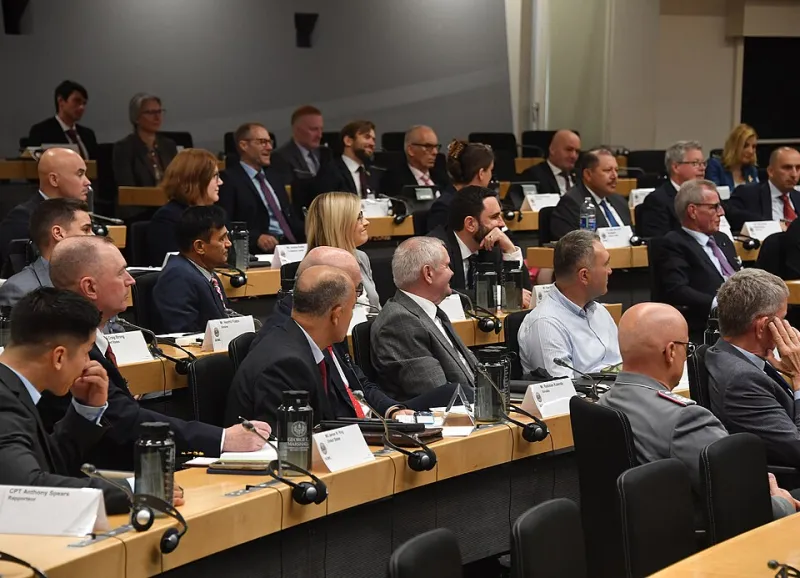
There is a thought experiment worth conducting the next time you sit in a room full of senior British leaders. Set aside the variations in sector, geography, and stated organisational values. Look instead at the shape of the leadership itself — the communication style, the decision-making posture, the way authority is signalled and exercised. In a striking number of cases, you will find that you are looking at variations on a single template.
This is not coincidence. It is the predictable output of a professional development ecosystem that has, largely without intention, optimised itself to produce one kind of leader.
How the Archetype Is Assembled
The homogenous British executive does not emerge from a single source. They are the cumulative product of several overlapping systems, each of which, in isolation, appears reasonable — even admirable.
Graduate recruitment processes at major UK employers have long favoured candidates from a narrow range of universities. The so-called target institution lists that shape early-career hiring filter for a particular kind of academic formation before any development has even begun. The individuals who enter these organisations are already, statistically, more similar to one another than to the broader working population.
Once inside, they encounter competency frameworks. These documents — ubiquitous across British corporate life — define what effective leadership looks like in terms that are specific enough to be assessable but broad enough to appear universal. The problem is that they are rarely truly universal. They reflect the accumulated assumptions of the organisations that designed them, encoding particular communication styles, particular approaches to authority, and particular cultural norms as objective standards of leadership quality.
Coaching and development programmes then reinforce these frameworks. Assessors are trained to identify and reward the behaviours the frameworks describe. Leaders who exhibit different but equally effective styles — those who lead through deep subject-matter authority rather than charismatic influence, or who build consensus through extended dialogue rather than decisive pronouncement — frequently find themselves rated as developmental cases rather than recognised as alternative models of excellence.
The result is a pipeline that functions less like a talent development system and more like a replication mechanism.
The Costs of Convergence
Organisational homogeneity carries risks that are well-evidenced and frequently underestimated. Diverse leadership teams — diverse not merely in demographic terms but in cognitive style, professional background, and leadership approach — consistently outperform their more uniform counterparts when navigating complex, rapidly changing environments.
The reason is structural. When a leadership team shares not only values but assumptions, decision-making processes, and cultural reflexes, it becomes systematically blind to precisely the challenges that fall outside its shared frame of reference. The risks it fails to anticipate, the opportunities it fails to perceive, and the talent it fails to develop are all concentrated in the space between what the dominant archetype values and what the organisation actually needs.
British businesses have experienced this dynamic with particular acuity in recent years. The strategic challenges posed by rapid technological disruption, shifting workforce demographics, and genuinely global competitive pressure require leadership responses that the conventional executive archetype was not designed to generate. Yet the development infrastructure continues to produce that archetype with impressive consistency.
The Assessment Design Problem
Perhaps the most consequential — and least examined — driver of leadership homogeneity is the design of assessment processes themselves. Psychometric instruments, assessment centres, and performance review frameworks are not neutral tools. They embody assumptions about what good leadership looks like, and those assumptions are rarely interrogated with sufficient rigour.
Many widely used leadership assessments were developed on samples that skew heavily towards particular demographics, sectors, and cultural contexts. Applying them as universal measures of leadership potential introduces a systematic bias that is invisible precisely because it is built into the instrument rather than into the assessor.
Assessment centre designs present similar challenges. The group exercises, presentations, and case studies that dominate British graduate and senior-level assessment processes tend to reward a specific kind of social confidence — the ability to perform leadership rather than to exercise it. Candidates who lead effectively through quiet authority, through the quality of their analysis, or through the depth of their relationships with team members are frequently disadvantaged by formats that privilege visibility and verbal assertiveness.
The organisations that build these processes are not, in most cases, acting in bad faith. They are applying the tools available to them, against criteria that reflect their existing understanding of excellence. But the cumulative effect is to consistently filter for a profile that resembles the leadership the organisation already has.
Reimagining the Development Architecture
Closing the archetype gap requires intervention at multiple points in the development pipeline — not as a diversity exercise, but as a performance strategy.
Audit your competency frameworks for embedded assumptions. The language in which leadership competencies are described carries significant cultural weight. Frameworks that describe effective leadership in terms of traits more commonly associated with particular cultural or demographic groups will systematically disadvantage candidates who lead differently but equally effectively. A rigorous audit, ideally conducted with external support, can surface these embedded biases before they shape hiring and development decisions.
Broaden assessment design to capture a wider range of leadership expressions. Supplementing conventional assessment centre formats with structured simulations that reward different leadership styles — collaborative problem-solving, technical authority, long-horizon strategic thinking — creates a more accurate picture of the leadership capability actually present in a candidate pool.
Commission coaches who challenge, not confirm. Executive coaching is most valuable when it expands a leader's repertoire rather than polishing their existing style. Organisations should seek coaches who are willing to question the underlying assumptions their clients carry about what effective leadership requires — and who are equipped to help leaders explore genuinely different approaches rather than refined versions of familiar ones.
Make leadership diversity visible at the top. Development cultures take their cues from what they observe in their senior leadership. When the executive tier consistently exemplifies a single leadership style, the implicit message to those progressing through the pipeline is clear. Actively surfacing and celebrating different leadership approaches at senior levels begins to shift the cultural expectation of what leadership can look like.
The Competitive Argument for Genuine Variety
The case for dismantling Britain's leadership archetype is not primarily an equity argument, though equity considerations are real and important. It is a competitive argument. Organisations that build genuinely varied leadership teams — varied in style, formation, cognitive approach, and professional background — are structurally better equipped to navigate the complexity that defines modern business conditions.
The archetype served its purpose in a more stable and less demanding operating environment. It produced leaders who were competent, credible, and culturally coherent. But competence and cultural coherence are no longer sufficient. What British organisations need now are leaders who can think in ways the organisation has not previously thought, who can perceive what the existing leadership cannot see, and who can build the kind of inclusive, adaptive cultures that attract and retain the talent the next decade will demand.
Building those leaders begins with the honest recognition that the current system is not developing them. It is developing one leader, over and over again, in slightly different packaging.
Peak performance, in any domain, requires the full range of human capability — not a polished replica of what came before.